
Every business
Automate quote and report drafting with AI, from your own live data
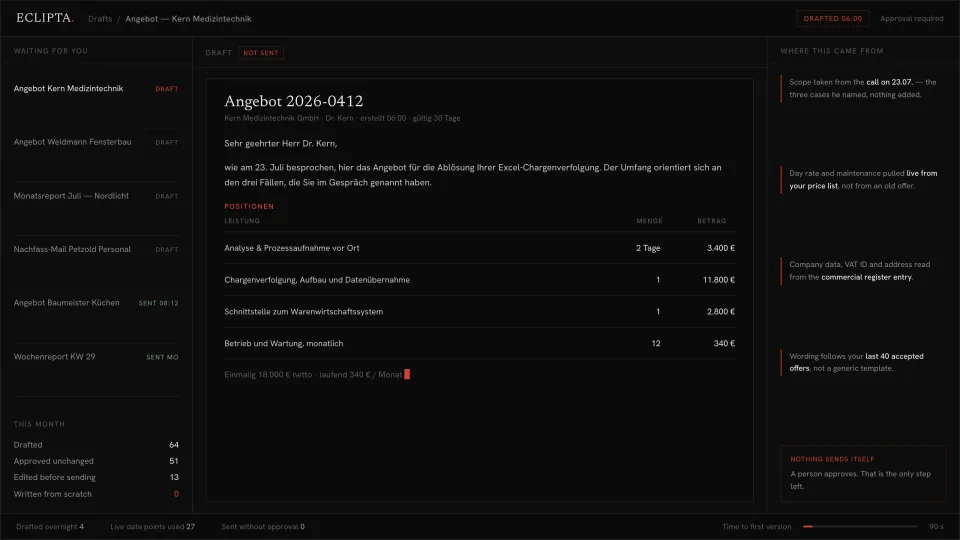
Quotes, monthly reports and follow-up emails, written before you sit down. The system pulls the figures from the systems you already run, writes in your house wording, and puts the draft in front of a person. Nothing is sent without approval, and no price is ever invented.
Why the first version of every document costs a morning
Almost no business document starts from nothing. A quote is the last quote with different line items. A monthly report is last month's report with new numbers. A follow-up email is the one you sent the client before, softened a little. The thinking took ten minutes in the meeting. The typing takes the rest of the morning.
The cost is not the writing. It is the retrieval. The scope sits in your notes from a call two weeks ago. The day rate sits in a price list that was updated in March. The client's legal name and VAT ID sit in the commercial register. The usage figures for the report sit in a dashboard nobody has opened since the last report. Every document is a small scavenger hunt across four systems, and the person doing it is usually the most expensive person available.
So it gets postponed. Quotes go out three days after the call, when the client has already asked someone else. Reports go out late or not at all. Follow-ups are the first thing dropped in a busy week. The work that suffers is not the difficult work, it is the work that only needed someone to start it.
And when it is done under time pressure, the old document leaks into the new one. A rate from the previous project survives, a paragraph still names the wrong client. Copying the last version is the fastest way to write a document and the most reliable way to send a wrong number.
- The quote is agreed in the call and still unsent four days later.
- Someone rebuilds the same monthly report structure every month by hand.
- A rate from an old proposal survives into a new one and nobody notices.
- Follow-up emails only get written when the week happens to be quiet.
- The person with the highest hourly cost spends it formatting tables.
- Nobody can say which version of the price list a sent quote was based on.
How a drafting system writes the first version for you
The built system does not wait to be asked. It watches for the trigger, a call that ended, a month that closed, a quote that has gone quiet, and produces the finished draft. Then it stops.
- 01
It notices the document is due
A meeting ends and a quote is expected. A month closes and reports are owed. A proposal has been open for eight days with no reply. The trigger comes from the systems you already use, not from someone remembering.
- 02
It gathers the facts from live sources
Scope from the notes of the actual call. Rates and maintenance fees from the current price list, not from an old offer. Company name, address and VAT ID from the register entry. Usage and delivery figures from the systems that hold them. Nothing is retyped, so nothing is mistyped.
- 03
It writes in your house wording
Your section order, your payment terms, your tone, your standard clauses, learned from the documents you have already sent and had accepted. The result reads like your firm wrote it, because the pattern came from your firm.
- 04
It marks what it could not verify
A figure with no live source is flagged, not filled in. A scope item that was discussed vaguely is written as an open question at the end of the draft. A draft with three flags is a correct result, not a failed run.
- 05
It hands the draft to a person and stops
The draft sits in a queue with the sources it used shown beside it: this rate came from the price list, this scope came from the call on the 23rd, this company data came from the register. A person reads, adjusts if needed, and sends. That approval step is not a formality that can be switched off later. It is the design.
Take this with you
A free prompt: meeting notes to a first quote draft
This is one handgrip out of the whole run, and it works today in any capable chat assistant. You paste in your notes from the call plus your own list of services and prices. It writes the first full version of the quote. Its central rule is the one that matters most in commercial documents: every figure is either traced to something you gave it, or left visibly open. It never invents a price.
You draft commercial quotes for a services business. You are writing
a first version for internal review. It will not be sent as you write it.

I will paste two things below:
  A. NOTES from the client conversation. Rough, unordered, incomplete.
  B. MY SERVICE AND PRICE LIST. This is the only source of prices.

YOUR TASK
Write a complete quote draft with these sections:
  1. Salutation and one sentence referring to the conversation and its date
  2. Understanding of the requirement, in three to five sentences,
     written only from what is in the notes
  3. Scope: what is included, as a clear list
  4. Explicitly out of scope: anything discussed but not being quoted
  5. Line item table: position, quantity or duration, unit price, total
  6. Totals: one-off total, recurring total, and the recurring interval
  7. Assumptions this quote depends on
  8. Validity period, payment terms and next step

ABSOLUTE RULES ON NUMBERS
Every price must come from my price list, unchanged. Never adapt a rate
to the client, never round, never "estimate a fair figure", never carry
a number over from any example you have seen before.
If the notes require a service that is not on my price list, write the
line item with the amount as:
  [PRICE MISSING: interface to inventory system]
If the notes do not say how many days or units, write:
  [QUANTITY MISSING: on-site analysis, days not agreed]
Do not compute a total that contains a missing value. Write the total as
a sum of the known parts plus the open items listed by name.
If the notes contradict themselves, write [CONFLICT: ...] and continue.

STYLE
Plain, factual, short sentences. No selling language inside the quote,
no "we are excited", no "tailored solution". Describe the work. Match
the language of my notes.

END WITH TWO LISTS
  A. CLARIFY BEFORE SENDING: every open item, every assumption that was
     inferred rather than stated, every missing quantity or price.
  B. CHECK AGAINST SOURCE: every figure used, with where in my input it
     came from, so a human can verify it in one pass.

NOTES:
[PASTE YOUR CALL NOTES HERE. MESSY IS FINE.]

SERVICE AND PRICE LIST:
[PASTE YOUR OWN RATES HERE.]- Paste the prompt, then your raw call notes and your current price list where marked. Use the real price list, not a remembered version.
- Read list A at the bottom before the draft itself. It tells you what the call actually left open.
- Fill the gaps, paste the input again, and let it rewrite. The second pass is normally the one you keep.
- Move the text into your own quote template and do the layout and the legal boilerplate yourself.
- Adapt the eight sections and the payment terms once, to match how your firm really quotes. That version is worth keeping.
It writes a solid first version, but only from what you hand it. A person still has to find the notes, open the current price list, look up the client's legal details and paste all of it in. It does not know your template, so the layout stays manual. It has not seen your last forty accepted quotes, so your standard clauses get reinvented each time. And it starts from zero every session, so nothing improves over time. The prompt turns pasted material into a draft. The built system finds the material itself, uses the version of the price list that is current today, writes in your format, and puts the draft in the approval queue with its sources attached.
Where the prompt ends and the drafting system begins
The difference is not the quality of the prose. Both write acceptable German or English business documents. The difference is who does the fetching, and whether the document can be defended afterwards.
A drafting system is pointed at the sources once: the notes, the price list, the register, the reporting data, the archive of documents you have already sent. After that it produces the first version without being asked, and every figure in it can be traced back to where it was read. When a client questions a line item three months later, you can answer from the record rather than from memory.
The rule that makes this safe is the same in every system we build. Anything unambiguous runs by itself. Anything ambiguous waits for a person. Anything touching money or a promise goes to a person by default. A quote is money and a promise in one document, so it is never sent automatically. The system removes the blank page, not the judgement.
- Triggers on its own when a call ends, a month closes or a quote goes quiet.
- Pulls rates from the price list as it stands today, never from an old document.
- Reads client legal details and figures from the systems that already hold them.
- Writes in the wording of the documents you have sent and had accepted.
- Flags every figure it cannot source instead of filling the gap.
- Shows each draft with its sources beside it, so review takes minutes.
- Sends nothing. A person approves, and that step is not removable.
Frequently asked questions
Can AI write a quote that is actually ready to send?
It can write a first version that a person only has to check, which is where almost all of the time goes. What it must never do is produce a price without a source. A model asked to quote a job it has no rates for will write a confident, plausible, wrong number. That is why the prompt on this page forces missing prices into visible markers, and why the built system reads rates from your live price list rather than from anything it saw before.
Can I not just do this with ChatGPT?
For one document, yes, and the prompt on this page is exactly that. What a chat window cannot do is notice that a call ended, open your current price list, look up the client in the register, pull last month's usage figures, write in your template and place the result in an approval queue. Every one of those steps stays with a person. That is workable for two quotes a month and expensive at two a week.
Does the system send anything by itself?
No. Drafting is automatic, sending is not, and that is a design decision rather than a setting. Quotes commit money and reports go to clients, so both categories always end in front of a person. In a running system the count of documents sent without approval stays at zero. What changes is that the draft is already there when you sit down, instead of being the reason you have not sat down.
How much time does automated drafting actually save?
The saving is not in typing, it is in retrieval and in delay. Gathering scope, rates, client details and figures across several systems is most of the work in a quote or a monthly report, and that part disappears. The larger effect is usually on timing: documents that used to wait for a free morning go out the same day. We look at your real documents before making any claim about your numbers.
What does it cost to automate quote and report drafting?
There is no list price, because nothing is being resold. The build is scoped to your documents, your data sources and your approval process. The honest comparison is against the hours currently spent assembling first versions, plus the value of quotes that go out the same day instead of three days later. We start with a scope conversation and tell you where a prompt would already be enough.
Where do our prices and client data go, and who can see them?
Your data stays yours. The system runs against your own storage and your own accounts, and we do not retain your documents. For teams with strict requirements it can be set up so that no document content leaves infrastructure you control. Price lists, margins and client terms are exactly the material that should not be pasted into a general chat tool, which is a further argument against working that way.
Will the drafts sound like our firm or like a template?
The wording is learned from documents you have already sent and had accepted, so the section order, the standard clauses and the tone are yours. This is the part that most rewards having an archive: forty accepted quotes teach the system more about how you write than any style instruction could. Where your own documents are inconsistent, that inconsistency shows up early and is worth fixing anyway.
Does this work for reports and emails too, or only quotes?
The pattern is the same for anything assembled from live data plus context: monthly client reports, project status updates, follow-up emails on open proposals, renewal notices, handover summaries. The sources differ, the logic does not. Every one of them ends the same way, with a draft waiting for a person rather than a message already sent.
Bring us one quote and one report
The quickest way to see whether this fits is with real documents. Bring the last quote you sent, the last monthly report, and the notes and price list they were built from. We will tell you honestly which parts a system could take over, which parts still need a person, and what building it would involve. If the answer is that the prompt on this page already covers you, we will say so.
Apply