
Every business
Meeting notes that file themselves into the customer record
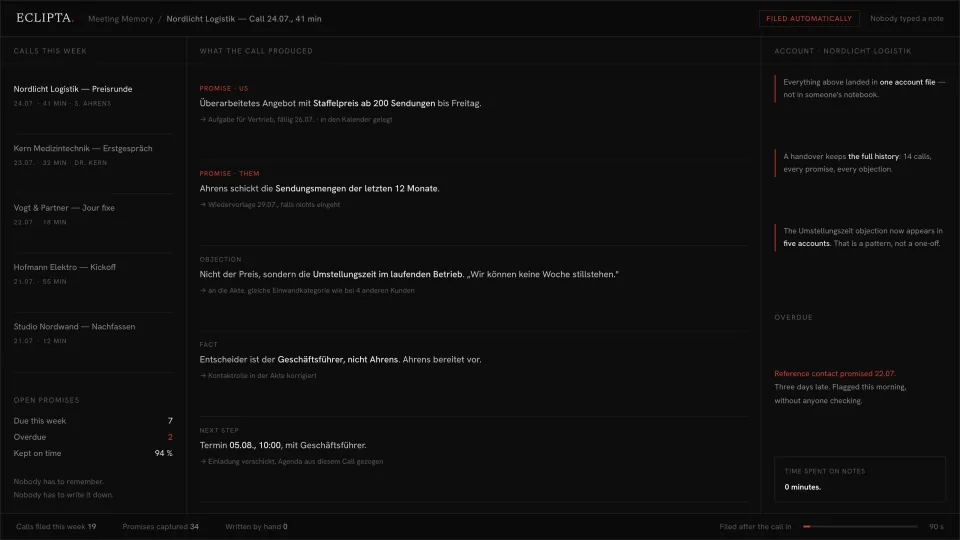
Every call produces decisions, promises with a date, and objections that matter later. Most of that survives for about a day, in one person's head. This system captures the call, sorts what came out of it into the right account file, and tracks the promises until they are kept.
Why the important half of every customer call disappears
The call goes well. Somebody says they will send the shipment volumes. You say you will come back with a revised offer by Friday. The real objection turns out not to be price at all, it is that they cannot stand still for a week during the switchover. Then the call ends, the next one starts, and the only record is three words in a calendar entry.
Two things go wrong from there. The first is short term: a promise made out loud is a promise, and nobody is watching the date. The second is slow and more expensive. Six months later somebody asks why this account stalled, and the answer existed once, in a sentence that was never written down.
It gets worse at exactly the wrong moment. When a colleague leaves or an account changes hands, the history goes with them. The new person inherits a folder of offers and invoices, which is the paperwork, and none of the conversation, which is the relationship. They start again, and the customer notices.
Written notes are not the fix either. People write them after the calm calls and skip them after the hard ones, which is backwards, and what does get written is smoothed. A customer who said the switchover time is unacceptable becomes a customer with reservations about implementation. The sharp version was the useful one.
- A commitment made on a Tuesday call is remembered until Thursday, then only by the person who made it.
- You know a customer objected to something, but not in which words, and the words were the point.
- The CRM says last contact 12.06. and nothing about what was said in it.
- The same objection has now come up in five accounts, and nobody has noticed, because it lives in five different heads.
- A handover means an hour of talking through accounts, and whatever gets forgotten in that hour is simply gone.
- Follow up depends on whoever remembers, which means the quiet accounts get followed up least.
How a call turns into an account record without anyone typing
The system sits on the calls you already have. It captures them with the participants' agreement, works out which customer the conversation belongs to, extracts the parts that have consequences, and writes them into that account file. Where it is unsure, it says so rather than filling the gap.
- 01
Capture the conversation, with consent
Video calls, phone calls or a recording from the room. Consent is part of the setup, not an afterthought: participants are told, the notice is built into the invitation and the start of the call, and anyone who declines is respected. This is the point where most of the legal question is settled, so it is settled first.
- 02
Route it to the right account
The call is matched to a customer from the participants, the calendar entry and the email domain. If two accounts are plausible, it does not pick one. It asks. A conversation filed under the wrong customer is worse than one filed nowhere.
- 03
Pull out what has consequences
Not a summary. Decisions taken, promises made by us with a deadline and an owner, promises made by them, objections in the words they were said in, facts that correct the file such as who actually decides, and the agreed next step. That list is what still matters in six months.
- 04
Turn promises into tracked items
Our promises become tasks with dates. Their promises become follow ups: if the shipment volumes have not arrived by the 29th, the account says so. Overdue is a system event, not something a person has to notice while doing something else.
- 05
Keep the account file whole
Everything lands in one place per customer, in order: fourteen calls, every promise, every objection, alongside the offers and the delivery history. A handover becomes reading rather than remembering.
- 06
Show the patterns across accounts
Once objections are recorded in consistent form, the same one appearing in five accounts is visible. That is the difference between a difficult customer and a problem with the offer, and it is not visible from any single call.
- 07
Stop where it is not certain
Unclear passages are marked as unclear, never smoothed into something plausible. Anything that reads like a price, a discount or a commitment is written down as said and routed to a person. The system files and flags. It does not decide, and it does not reply to the customer.
Take this with you
A prompt that turns a transcript into a record that still works in six months
Paste in a transcript or your own rough notes from a call and this returns the file entry: decisions, promises with dates and owners, objections in the original wording, open questions, next step. The rule it follows is the one that matters: nothing gets smoothed, nothing gets invented, and everything the conversation left open is marked as open instead of guessed.
You write the account record for a customer conversation. Your only source is
the transcript below. You may not add anything that is not in it.

TRANSCRIPT OR NOTES
[PASTE THE TRANSCRIPT, THE AUTOMATIC CAPTIONS, OR YOUR OWN ROUGH NOTES.
Broken sentences and typos are fine. Do not clean them up before pasting.]

CONTEXT
[ONE OR TWO LINES: customer name, who was on the call, what it was about,
what stage the relationship is at.]

Write these six sections, in this order, as plain headed lists.

1. DECISIONS
Only things that were actually settled on the call. For each: what was
decided and who agreed to it. If something sounds decided but nobody
confirmed it, it does not belong here. Put it in section 5.

2. PROMISES BY US
Everything we said we would do. For each: what exactly, by when, and who
owns it. If no date was named, write "no date agreed". If no owner was
named, write "no owner named". Never infer a date or an owner from context.

3. PROMISES BY THEM
The same for what the customer said they would do, in the same three fields.

4. OBJECTIONS AND CONCERNS
Every reservation, hesitation or complaint. Quote the customer's own words
in quotation marks, in the language they used, then add one line on what it
appears to be about. Do not soften. If they said something is impossible,
write impossible, not challenging. Where the objection is about price,
timing, risk or trust, name which.

5. OPEN AND UNCLEAR
Two lists: questions raised and not answered, and points where the
transcript is ambiguous, contradictory or inaudible. Write each one as
"not clarified on the call: ...". A long section 5 is a correct result.

6. NEXT STEP
The single next action that was agreed, with a date if one was named. If
none was agreed, write "no next step agreed on the call" and stop.

Rules that override everything above. Never summarise or paraphrase in
sections 2, 3 and 4. No advice, no tone readings, no judgement about how
the call went. Never fill a gap with the most likely answer. Anything
touching a price, a discount or a commitment is recorded word for word and
marked "needs human confirmation".
- Get a transcript: your meeting tool's export, the automatic captions, or your own notes written straight after the call.
- Tell the participants you are recording or transcribing, and get their agreement before you do it, not after.
- Paste it in with two lines of context, run it, and read section 5 first. The open points are the reason to run this at all.
- Copy the result into the customer's file or CRM under the call date, so it sits with the rest of the account.
- Put every promise from sections 2 and 3 into whatever actually reminds you: calendar, task list, CRM. The prompt cannot do that part.
This produces one good record of one call. Someone still has to obtain the transcript, run the prompt, and paste the result into the right file, and if that person is busy on Friday the call is not recorded at all. It has no memory of the previous thirteen conversations with this customer, so it cannot tell you that the same objection came up in four other accounts. It writes down a promise due on the 26th and then forgets it exists. Nothing happens when the date passes.
From one written up call to a customer history that keeps itself
The prompt gives you a record when you remember to make one. The built system removes the remembering. The call is captured, matched to the customer, extracted and filed, and the promises inside it are tracked from that moment until they are kept or overdue. Nobody types a note, and the file is complete on the accounts nobody had time for.
That changes what a handover is. Instead of an hour of talking through accounts and hoping, the new person reads fourteen calls with every promise and every objection in the words they were said in. The relationship transfers, not just the paperwork.
It also changes what you can see. One customer worrying about the switchover time is a conversation. Five is a product problem, and you only find that out if the sentence survived in all five files.
The honesty rule from the prompt stays in force in the built version, because it is what makes the record usable. What was unclear on the call is marked unclear. What sounded like a price or a commitment is preserved word for word and put in front of a person. The system files and flags. Deciding, replying and negotiating stay with humans.
- Calls are captured and filed to the right account automatically, including the ones nobody would have written up.
- Promises made by both sides become tracked items with dates, and overdue is flagged without anyone checking.
- Objections are kept in the customer's own wording, so a pattern across accounts becomes visible.
- A handover hands over the full history, not a folder of offers.
- Ambiguous calls are flagged for a person rather than resolved by guessing, and anything about money goes to a human by default.
- Runs on your infrastructure, with retention rules and access rights you set, so you can answer where the recordings live.
Frequently asked questions
Is it legal to record customer calls?
Only with the agreement of everyone on the call, and in Germany that agreement has to be real, not buried in a footer. In practice this means the notice is in the invitation and repeated at the start of the call, and anyone who says no is not recorded. It also means deciding up front how long recordings are kept and who may listen to them. We treat consent and retention as part of the setup, because a system built without them is not usable regardless of how good the notes are.
Where do the recordings and transcripts end up?
That is a decision you make before anything is built, and it belongs in the decision. Recordings and transcripts can stay on your own infrastructure, and the model that reads them can run there too, which is the usual answer when calls contain customer data or prices. If you prefer a hosted model, you choose which one and what it is allowed to see. What you should never accept is not knowing the answer to this question.
Can I not just do this with ChatGPT?
For a single call, yes, and the prompt on this page is exactly that. What a chat window cannot do is be there for the next call, and the one after. It does not know which customer this conversation belongs to, it has never seen the previous thirteen, and it forgets the promise due on Friday the moment you close the tab. The built system runs without anyone starting it, which is the whole point on the accounts you are too busy to write up.
How is this different from the AI notes my meeting tool already gives me?
Meeting tools produce a summary of the call. A summary is the wrong shape for a customer file: it smooths the objection you needed in its original wording, drops the promise that had no date, and lives in the meeting tool rather than on the account. This system extracts the parts with consequences, keeps the wording, files them under the customer, and tracks the promises to a date. It is a record, not a recap.
Will it contact customers or follow up on its own?
No. It flags what is overdue and prepares what is needed, and a person sends it. Anything involving a price, a discount or a commitment to a customer goes to a human by default, without exception. The system records what was said and reminds you what you promised. Saying the next thing to your customer stays your job.
What does it cost and how long does it take to set up?
The first useful version is a matter of weeks, because it starts with one call type and one account file rather than every meeting in the company. Cost is a build plus hosting, not a per user fee, and the honest figure depends on where the calls happen and where the record has to land. We say before the build which parts are worth automating and which are cheaper left manual.
Bring us last week's calls
If the prompt above surfaced a promise you had forgotten or an objection you had softened in your memory, that gap is the project. Apply, tell us how your calls happen and where the customer record lives, and we will tell you honestly whether this is worth building for you.
Apply