
Every business
Ask questions about your own company data and get a sourced answer
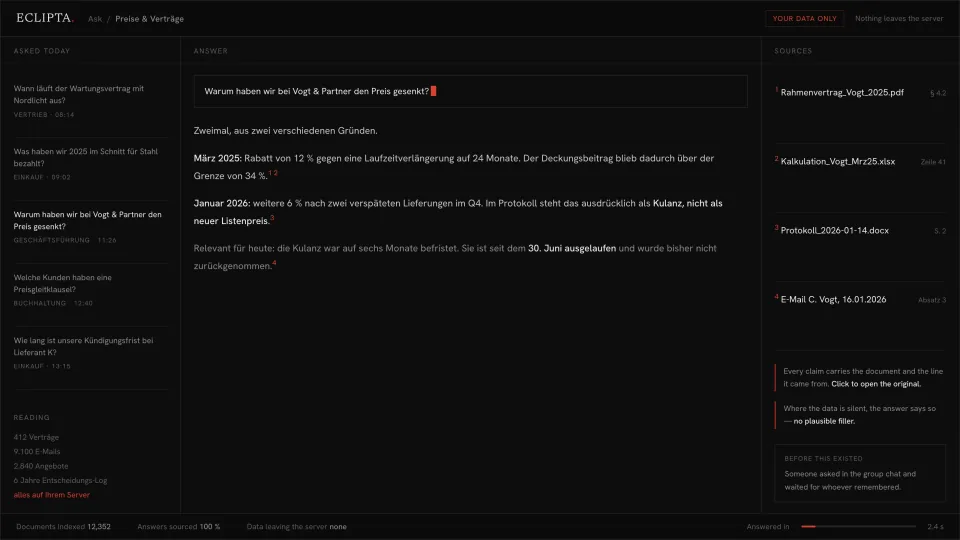
Prices, contracts, decisions, history. The system answers from your own data and names the source. Every claim carries the document and the line it came from, and where the data is silent the answer says so instead of filling the gap.
Why nobody in the company can answer simple questions
The question sounds trivial. Why did we drop the price for that client last year? When does the maintenance contract expire? What did we pay for steel on average? Every answer exists somewhere in the company. It sits in a framework agreement, in a spreadsheet row, in the minutes of a meeting, in an email thread three people were on. The information is not missing. It is unreachable.
So the question goes into the group chat and waits for whoever remembers. Sometimes the right person answers in five minutes. Sometimes they left in March, and what comes back is a reconstruction. Nobody can tell a remembered fact from a checked one, because neither comes with a source.
Full text search does not solve it either. The answer is usually not in one document. It is the combination of a clause, a calculation and a note somebody wrote afterwards explaining why. Finding those three things and putting them together is the actual work, and nobody has time for it.
General chat assistants are a trap here specifically. They answer either way. Asked about a contract they have never seen, they produce something fluent and plausible. In a company context, a confident wrong answer about a notice period or a discount is worse than no answer at all.
- The same question gets asked in the group chat every few months.
- The person who knows why a decision was made has left the company.
- Searching the shared drive returns hundreds of files and no answer.
- Two departments quote different numbers for the same contract.
- A commitment made in an email never made it into anyone's records.
- Nobody can say afterwards which document a figure actually came from.
How internal question answering with sources actually works
The built system is not a chat window you paste documents into. It is connected to the material your company already produces and keeps producing, and it answers from that material only.
- 01
It indexes the material where it already lives
Contracts, offers, invoices, email archives, meeting minutes, the folders on the file server. No export project, no migration, no asking people to file things differently. New documents are picked up as they appear.
- 02
It finds the right passage, not the right file
A question about a price reduction pulls the clause from the framework agreement, the row from the calculation sheet and the paragraph from the minutes that explains the reasoning. Retrieval happens at the level of the passage, which is why the answer can be short.
- 03
It answers in plain language and cites every claim
Each statement carries the document and the position inside it: the section of the contract, the row of the spreadsheet, the page of the minutes. The citation opens the original, so an answer can be checked in seconds rather than trusted on faith.
- 04
It separates what is documented from what follows from it
The documented facts come first. Any conclusion the system draws, for example that a temporary discount has quietly expired and was never withdrawn, is marked as its own reasoning and kept apart from the evidence.
- 05
It says when the data does not contain the answer
If nothing in the indexed material answers the question, that is the answer. It names what it searched and what would probably contain the missing fact. No plausible filler, ever. This is the single behaviour that decides whether people keep using the system after month two.
- 06
It respects who is allowed to see what
Answers are bounded by the asking person's access rights, so salary data or board minutes do not surface through a side door. Everything runs against storage you control, and it can be set up so that no document content leaves your infrastructure at all.
Take this with you
A free grounding prompt that refuses to invent answers
Here is the smallest useful piece of that, and it works today in any capable chat assistant. It is a grounding prompt: it answers only from material you paste in, quotes the exact sentence behind every claim, says clearly when the answer is not in the documents, and keeps its own reasoning visibly separate from the evidence. It will not make anything up. That single constraint is what turns a chat assistant into something you can use on a real contract question.
You answer questions strictly from source documents I provide.
You are not a general assistant. You have no knowledge of my company
beyond what appears between the SOURCES markers below.

HOW TO ANSWER
Structure every answer in exactly these three parts:

1. ANSWER
   Two to six sentences, plain language, direct. Answer the question
   that was asked, not a broader version of it.

2. EVIDENCE
   For every factual claim in part 1, one line:
   [S<n>] "<exact sentence or figure, quoted verbatim from the source>"
        -> location: <document name, section / page / row / date>
   Every claim needs at least one line. A claim you cannot quote is
   not a claim you may make.

3. MY REASONING (only if applicable)
   Anything you concluded, combined or inferred that is NOT stated
   in the sources. Label each one and say what it rests on. Example:
   "The sources do not say the discount was withdrawn. Since [S3]
   sets an end date and no later source mentions it, it appears to
   still be running. This is my inference, not a documented fact."

ABSOLUTE RULES
- Use only the sources below. Do not use general knowledge, industry
  norms, typical contract terms, or anything you know about how such
  agreements usually work.
- If the sources do not contain the answer, write exactly:
  "Not in the documents provided."
  Then name what would normally contain it, for example: "This would
  usually be in the framework agreement or the order confirmation."
  Do not soften this, do not guess, do not offer a likely answer.
- If two sources contradict each other, do not choose between them.
  Quote both, label it CONTRADICTION, and say which is more recent.
- If the sources answer only part of the question, answer that part
  and state plainly which part is not covered.
- Never paraphrase inside EVIDENCE. Quote word for word.

SOURCES
[PASTE YOUR DOCUMENTS HERE. LABEL EACH ONE S1, S2, S3 AND GIVE IT A
NAME AND A DATE, FOR EXAMPLE:
S1 = Framework agreement, client X, signed 2025-03-11
S2 = Minutes, management meeting, 2026-01-14
S3 = Email from C. Vogt, 2026-01-16]

QUESTION
[YOUR QUESTION HERE]- Paste the prompt, then paste your documents under SOURCES. Label each one and give it a date, because the date is what resolves contradictions later.
- Ask one narrow question at a time. Broad questions produce broad answers that are harder to verify.
- Read the EVIDENCE section before the ANSWER section. If a claim has no quote behind it, treat the claim as unverified.
- Store it permanently instead of pasting it every time: as the instructions of a Claude Project, or as the instructions of a custom GPT, with your recurring documents uploaded as project knowledge. Then you just ask the question.
- When you get "Not in the documents provided", note which document was missing. That list is a useful map of where your knowledge actually sits.
It can only answer from what somebody pasted in. That is the whole difference. You have to know in advance which contract, which minutes and which email thread are relevant, which means you have to already half know the answer to find it. It cannot search six years of correspondence, it cannot notice a related clause in a document you did not think of, and a chat window has a limit on how much you can paste before older material falls out of view. It also has no idea who you are, so it cannot respect access rights. And every session starts from nothing again.
Where the prompt ends and the built system begins
The prompt makes a chat assistant honest. The system makes the company's own memory searchable. Those are different problems, and the second one is where the time goes.
The gap is retrieval. A person using the prompt has to locate the sources first, which is most of the work and requires knowing they exist. The system reads the whole archive, finds passages nobody would have thought to look for, and returns the location so the answer can be checked against the original.
The principle underneath is the same one that runs through every system we build. Whatever is unambiguous runs on its own. Whatever is ambiguous stops and waits for a person. Anything touching money or a commitment goes to a person by default. The system does not guess, and it is not built to look confident. An answer that says the data is silent is a correct answer, and it is the reason people still trust the answers that are not.
- Searches contracts, offers, emails, minutes and file shares in one question.
- Cites the document and the exact position, and opens the original on click.
- Finds the relevant passage even when you did not know the document existed.
- Keeps documented facts and its own conclusions visibly separate.
- Says the data is silent instead of producing a plausible answer.
- Enforces existing access rights, so nothing surfaces through a side door.
- Runs against storage you control, with no document content leaving your servers.
Frequently asked questions
How can I ask questions about my own company documents with AI?
Two ways, at very different levels. The prompt on this page works today: you paste the relevant documents into a chat assistant and it answers from those only, with quotes. The built version is connected to your archives directly, so you ask without knowing in advance which document holds the answer. The first suits a single contract question. The second is what makes it a habit across a team.
Can I not just do this with ChatGPT?
For a question about documents you already have open, yes, and the prompt above is exactly that. What a chat window cannot do is search six years of contracts and correspondence you never uploaded, notice a clause in a document you did not think to look for, respect who is allowed to see what, or stay current as new files arrive. It also answers confidently when it has no basis to, which is why the prompt on this page spends most of its length forbidding that.
How do I stop AI from making up answers about internal data?
By constraining it to provided sources and forcing it to quote. Three rules do most of the work: answer only from the material given, quote the exact sentence behind every claim, and use a fixed phrase such as "Not in the documents provided" when the answer is absent. The built system applies the same discipline structurally: every statement carries a document reference, and an answer that cannot be sourced is not produced.
Where does our data go and who can see it?
Your data stays yours. The system runs against your own storage and your own accounts, and it can be set up so that no document content leaves infrastructure you control. Answers are bounded by the asking person's existing access rights, so a question does not become a way around permissions. Contracts, prices and internal minutes are precisely the material that should never be pasted into a general chat tool.
What does it cost to set up an internal question answering system?
There is no list price, because nothing is being resold. The cost is driven by how many sources need connecting, how clean they are and how strict the access rules have to be. The honest comparison is against the hours currently spent hunting for answers, and against the cost of one decision made on a half remembered number. We scope it first and you see the real answer before committing to anything.
What happens when two documents contradict each other?
Both get shown. Nothing is averaged, chosen or smoothed over. If the framework agreement says one thing and a later email says another, the answer names both, marks the contradiction and points out which is more recent. Contradictions surface earlier this way than they normally would, and for most teams that is one of the first things they notice after switching it on.
Does it work with our emails and meeting minutes, not just formal documents?
Yes, and those are often where the real answers sit. The reason behind a price decision is rarely in the contract. It is in the minutes and in the email thread afterwards. Anything readable as text can be indexed: correspondence, minutes, offers, invoices, notes, scanned documents once they are recognised. The citation still names the message and the paragraph.
Bring us five questions
Write down five questions your team actually asked last month and could not answer quickly. Bring those, and the folders where the answers should be. We will tell you honestly which ones a system could answer with a source, which ones your records simply do not contain, and what it would take to build. If the prompt on this page is enough for you, we will say that too.
Apply