
SN Creative · Nemanja, Founder
Seven clients signed in one week.
SN Creative is a creative agency run by Nemanja. In one focused week, seven clients signed. What follows is not their internal story but ours: the system we build to carry a deal from the first message to the signature, and the points where it stops and puts the decision in front of a person.
- Company
- SN Creative
- Person
- Nemanja, Founder
- Result
- 7 new clients, 7 days
Where new business stalls in a small agency
In a small agency, the people who sell the work are the people who do the work. A good enquiry arrives on Monday, and the honest answer is that it will get a proper reply once the current project ships. By then the enquiry has cooled, and the agency has quietly decided that this is what pipeline feels like.
The proposal is usually the bottleneck. Writing one from scratch takes an evening, because it means remembering what was said on the call, digging out the closest thing from a past project, and deciding a price without the price list in front of you. Work that takes an evening does not happen on a busy week, so it slips, and the slip is invisible until the client stops replying.
The second bottleneck is the follow up, and it runs on memory. Someone remembers that the client wanted to check with a partner, and someone does not. The deals that get chased are the loud ones. The quiet ones, which are often the fit ones, get chased last or not at all.
Underneath both sits the same gap. What was actually promised on the call lives in one person's head. When the proposal is written a week later, the scope is reconstructed rather than recalled, and every reconstruction loses a detail that mattered to the client.
- An enquiry arrives on a delivery day and gets a real answer four days later.
- The proposal waits for an evening that never comes, and the client reads the delay as disinterest.
- Every proposal starts from a blank page, even though a close version of it was written three months ago.
- Prices get decided in the document rather than read from a list, so two similar projects are quoted differently.
- The follow up depends on who remembers, and the polite clients are the ones who get forgotten.
- A question about timeline or scope waits until someone has time to look through the thread and find what was agreed.
What the system does between first contact and signature
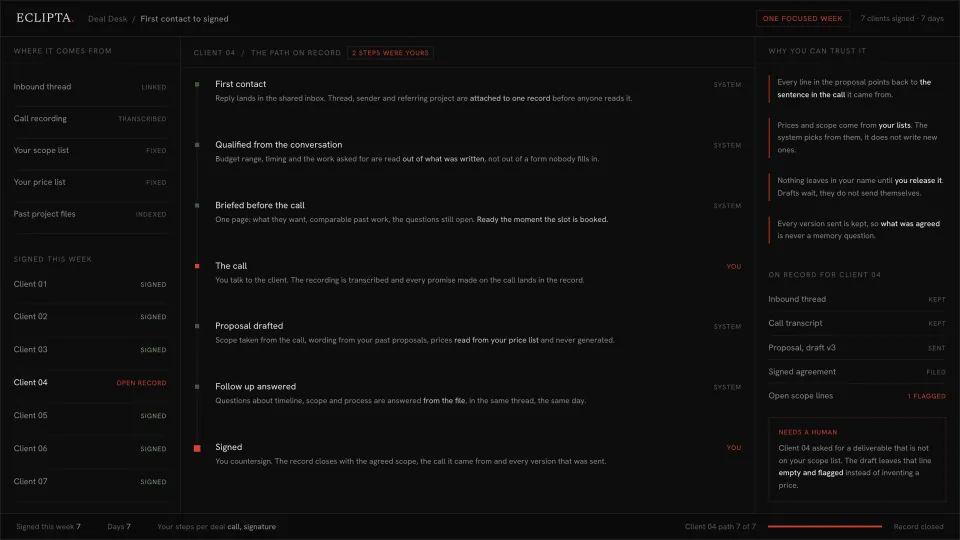
The system does not sell. It removes the work that sits between an enquiry and a decision, so the only two steps left for a person are the conversation and the signature. Everything it produces is traceable back to something you said or wrote, and where the source runs out, it stops.
- 01
Every enquiry becomes a record
The reply lands in the shared inbox and is attached to one record before anyone reads it: the thread, the sender, where they came from and any earlier contact with the same company. Nothing sits in a personal mailbox waiting to be forwarded.
- 02
Qualified from what was written, not from a form
The budget range, the timing and the work being asked for are read out of the message and the thread. Clients answer that in their own words already. Asking them to repeat it in a form is a step that loses people.
- 03
A briefing before the call
One page, ready the moment the slot is booked: what they appear to want, the comparable work you have already delivered, and the questions still open. Nobody prepares a call at the last minute, because the preparation is already there.
- 04
The call goes on record
You have the conversation. The recording is transcribed with the participants' agreement, and every promise made in it lands in the record in the wording it was said in. The scope stops being a memory exercise.
- 05
The proposal drafts itself from the call
Scope comes from the conversation, wording from your own past proposals, prices read from your price list. The system selects from what you have. It does not invent a price and it does not write a new service into existence.
- 06
Follow up answered from the file
Questions about timeline, scope or process are answered from the record, in the same thread, the same day. Chasing is a system event with a date on it, so the quiet clients get the same attention as the loud ones.
- 07
Signature, then the record closes
You countersign. The record keeps the agreed scope, the call it came from and every version that was sent, so what was agreed is never a memory question later, including when the project team takes over.
- 08
It stops where your list stops
If a client asks for a deliverable that is not on your scope list, the draft leaves that line empty and flags it. The system does not price it, does not guess a comparable, and does not send anything in your name until you release it. An empty line in front of a human is the correct output.
What came out of it
SN Creative turned one focused week into seven signed clients. That is the approved figure and the whole of it. We are not going to dress it up with a conversion rate we did not measure or a revenue number nobody gave us.
What we will say is what the system changes about a week like that. The time between an enquiry and a proposal stops depending on whether it was a delivery day. The follow up stops depending on who remembers. The person selling turns up to the conversation prepared and then goes back to the work, which is the only part of this that a creative agency should be spending evenings on.
- Seven clients signed in one week.
- 7 new clients, 7 days.
- The steps the system leaves to a person on any deal: the call, and the signature.
What this case does not claim
Seven clients in one week is a result, not a rate. It happened once, in one focused week, at one agency, and we are not offering it as a forecast for anyone else. Nothing on this page says that a system produces demand, and it does not: the enquiries have to exist first, and the work has to be worth signing.
Everything on this page beyond the company, the person and that one figure is our own description of what we build, written in the general. It is not a report on how SN Creative runs internally, and we have deliberately left out the details we would need to invent to make the story rounder.
Frequently asked questions
How do you write agency proposals faster without sounding generic?
The speed comes from removing the reconstruction, not from writing less. The scope is taken from the recorded conversation in the client's own wording, the phrasing comes from proposals you have already sent and stood behind, and the prices are read from your list rather than decided in the document. What arrives is a draft that already sounds like you, so the work left is judgement rather than typing.
Can I follow up properly if nobody keeps the CRM up to date?
That is the usual situation, and it is why the follow up should not be a discipline problem. When every enquiry becomes a record automatically, the dates come with it, and an unanswered proposal from nine days ago surfaces on its own. Nobody has to remember, and nobody has to maintain a pipeline board in the evening for the reminders to work.
Will it contact my clients or send proposals on its own?
No. Drafts wait until you release them, and nothing leaves in your name without that step. The system prepares, files and flags. Sending, negotiating and deciding stay with you, and anything touching a price or a commitment goes in front of a person by default.
What happens when a client asks for something not on my price list?
The draft leaves that line empty and marks it for you. It does not estimate, it does not pick the nearest item, and it does not quietly widen the scope to make the document look finished. A flagged gap costs you two minutes. An invented price costs you the margin on the project and sometimes the relationship.
How does this close clients without sales pressure?
By removing the reasons a good fit goes cold. Most lost deals in a small agency are not lost to objections, they are lost to a four day silence, a proposal that missed what was actually asked for, or a question that went unanswered for a week. Answering the same day from an accurate record is not a technique. It is the thing pressure is usually a substitute for.
Is recording sales calls allowed?
Only with the agreement of everyone on the call, and that agreement has to be visible rather than buried in a footer. In practice the notice sits in the invitation and is repeated at the start, and anyone who declines is not recorded. How long recordings are kept and who may access them is decided before anything is built, not after.
How long does a system like this take to set up?
The first useful version is a matter of weeks, because it starts with one enquiry route and one proposal type rather than every path into the business. Your price list and your past proposals are most of the input, which is also why the honest answer depends on what shape those are in today. We say before the build which parts are worth automating and which are cheaper left manual.
Bring us the enquiries you have not answered yet
If there is a proposal sitting unwritten and a client waiting on a reply, that gap is the project. Apply, tell us how enquiries reach you and where your prices and past proposals live, and we will tell you honestly whether this is worth building for you.
Apply