
Recruiting and HR
AI candidate matching that reads the profile, not the keywords
A system that reads your entire talent pool against one role and returns the people who actually fit, in seconds. Every match comes with the line in the profile that justifies it, and the gaps are named instead of hidden behind a score. It sorts and explains. The decision about a person stays with a person.
Why keyword search keeps returning the wrong shortlist
Most recruiting databases search for words. A role asks for VOB experience, so the search returns everyone with VOB in their profile. It finds the candidate who once attended a half day seminar and misses the candidate who ran claim management on two sites for four years and never wrote the three letters anywhere. The person who fits best is often the one who described the work rather than labelled it.
So the search gets widened, and now there are eleven hundred results. Someone opens them one by one. On a good day that is a day of work per role, and it happens under time pressure, at the end of a week, after forty profiles have already blurred together. The last profiles in the stack get less attention than the first ones. Everybody knows this and nobody has the hours to fix it.
Meanwhile the criteria live in someone's head. Two recruiters filling the same role apply slightly different bars, and neither can reconstruct afterwards why a particular profile was set aside. That is uncomfortable when a hiring manager asks, and it is worse when a candidate asks.
- The strongest profile never uses the word the search was built around.
- Widening the search turns eleven hundred hits into a day of manual reading.
- Profile forty gets a fraction of the attention profile four got.
- Good candidates already in your database get rediscovered by accident, months later.
- Nobody can say afterwards which criterion moved a candidate up or down.
- The requirements in the job ad and the requirements actually applied are not the same list.
How a matching engine reads a talent pool
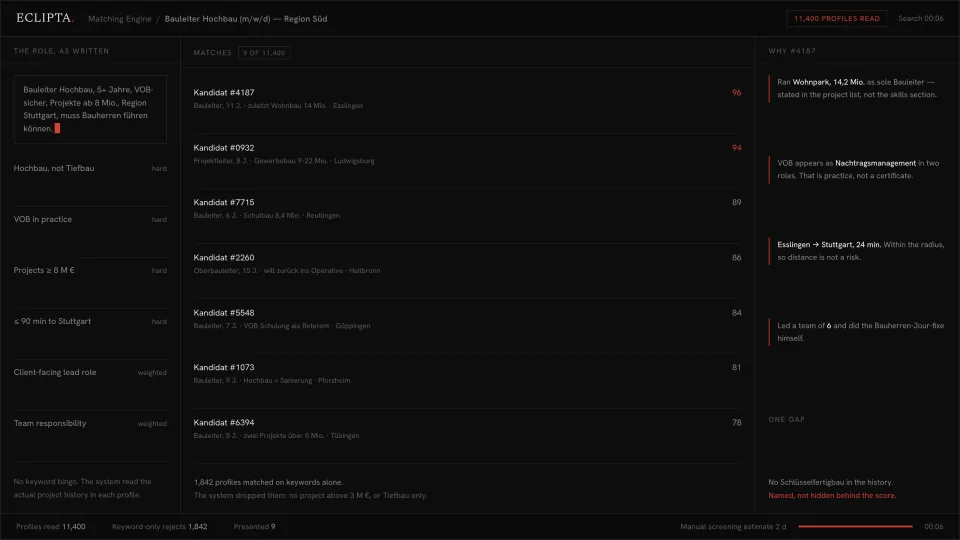
The built system is pointed at the role and at your existing pool: applicant database, CV archive, past applicants, sourced profiles. It does the reading, and it shows its work. A run looks roughly like this.
- 01
It turns the role into an explicit criteria set
The written requirement becomes a visible list. Hard criteria that a person must meet, such as the type of construction or a realistic commute. Weighted criteria that make someone stronger or weaker, such as client facing responsibility or team lead experience. The list is on screen and editable before a single profile is read, because a criterion you cannot see is a criterion you cannot correct.
- 02
It reads the whole pool, not the top of it
Every profile in scope gets the same reading, the eleven thousandth as carefully as the first. It reads the project history and the described work, not just the skills section. Attention does not decay, which is the one thing manual screening cannot promise.
- 03
It matches on substance and rejects keyword noise
A profile that mentions the right words but shows no project anywhere near the required size does not survive. A profile that never uses the required term but shows the work under a different name does. In a live run you can see both counts, including how many keyword matches were dropped and why.
- 04
It shows the evidence for every match
For each candidate presented, the specific lines that justify the ranking: the project that meets the size threshold, the role that shows the responsibility, the distance that makes the commute realistic. No score without a reason attached to it.
- 05
It names the gap instead of burying it
Every presented profile also carries what is missing or unclear. A candidate can rank highest and still come with a stated gap. That is the point. A shortlist that only shows strengths is a shortlist you cannot check.
- 06
It stops at the decision
The system produces a ranked, evidenced shortlist. It does not send rejections, it does not remove people from your pool, and it does not decide who is out. A recruiter reviews the list, looks at what was set aside, adjusts the criteria if the criteria were wrong, and runs it again. Every hiring decision stays a human one.
Take this with you
A free prompt: job ad to scoring matrix to a screened CV
This is the smallest useful piece of the above and it works today in any capable chat assistant. It runs in two steps. First it turns a job ad into an explicit scoring matrix, where every criterion carries the question of how you would actually recognise it in a CV. Then it scores one pasted CV against that matrix, with a quoted line as evidence for each point and a mandatory list of what it cannot judge from the document. Used well, it makes your criteria visible before it makes any judgement.
You are an experienced recruiter building a screening standard for one
role. You work in two steps and you wait for me between them.

STEP 1: BUILD THE MATRIX
I paste a job ad. Turn it into an explicit evaluation matrix:

  A. HARD CRITERIA (a profile without these is not a fit for this role)
     Maximum five. Only things genuinely non negotiable, such as a
     licence, a required qualification, a realistic commute, a minimum
     project size. If the ad implies more than five, tell me the ad is
     overloaded and propose which ones are really hard.

  B. WEIGHTED CRITERIA (these make a candidate stronger or weaker)
     Six to ten, each with a weight from 1 to 5.

For EVERY criterion give me three lines:
     Criterion:
     Why it matters for this role:
     How I would recognise it in a CV: [what would actually appear in
     the document, including the wordings people use when they do NOT
     use the obvious term]

Then stop and ask me to confirm or correct the matrix. Do not score
anything yet.

STEP 2: SCREEN ONE CV AGAINST THE CONFIRMED MATRIX
I paste one CV. Produce, in this order:

  1. HARD CRITERIA, one line each: met / not met / not stated in the
     document, plus the quoted line from the CV that shows it.
  2. WEIGHTED CRITERIA, one line each: score 0 to 5, the weight, and
     the quoted line from the CV that justifies the score.
  3. TOTAL, as weighted sum, with the arithmetic shown.
  4. EVIDENCE OF SUBSTANCE: where the CV shows the actual work even
     though it never uses the term from the ad.
  5. OPEN GAPS: what the role needs that this document does not show.
  6. WHAT I CANNOT JUDGE FROM THIS DOCUMENT: mandatory, never empty.
     Everything a CV cannot tell you, such as motivation, working
     style, reason for leaving, how the person handles a difficult
     client. Say plainly that these belong in a conversation.

ABSOLUTE RULES
Score only what is written in the document. Never infer a skill from a
job title, an employer name or a school. Where the CV is silent, write
"not stated in the document", never "probably" and never "likely".
Never quote a line that is not in the CV.
Never assess, mention or infer age, gender, origin, nationality, name,
photo, family status, health, religion, or any other personal
characteristic. If the ad asks for any of these, refuse that criterion
and say why.
You do not recommend rejecting anyone. You produce evidence for a human
decision. Your output ends as a recommendation to look closer or to
prioritise, never as a verdict on a person.

JOB AD:
[PASTE THE JOB AD HERE]- Paste the prompt, then the job ad. Read the matrix before you read anything else. If a criterion looks wrong, it was wrong in the ad too.
- Correct the matrix in your own words and confirm it. This is the step that pays off, because the same matrix now applies to every CV you screen for this role.
- Paste one CV. Check each quoted line against the actual document before you trust the score.
- Read section 6 first when the score is high. A strong number with three unjudgeable items is a reason for a call, not a reason to skip one.
- Save the confirmed matrix as a text file and reuse it for the whole role, so every candidate is measured against the same standard.
It reads one document at a time, pasted by you. Twelve candidates means twelve pastes and twelve reads, and by the tenth the matrix in the conversation has usually drifted. It cannot search your database, so it only ever sees the profiles you already thought to look at, which is exactly the group where the missed candidate is not. It knows nothing about the roles you filled last year and nothing about the person who applied for something else in March and would fit this. And the moment you close the tab, the matrix and every judgement are gone. The prompt scores a CV that a person hands it. The built system reads the entire pool, holds one matrix consistently across every candidate and every role, and returns the evidenced shortlist in seconds instead of days.
Where the prompt ends and the matching engine begins
The difference is not the quality of the judgement on a single CV. On one document, a good prompt and a built system reason similarly. The difference is coverage, consistency and memory. One is a careful reader you hand pages to. The other reads the shelf.
Coverage is where the money is. The candidate you never opened costs more than the candidate you scored slightly wrong, and manual screening under time pressure will always leave profiles unopened. A system that reads all of them applies the same standard to the eleven thousandth profile as to the first.
Consistency is where the defensibility is. When the criteria are written down, weighted and visible, you can answer why someone was prioritised, you can show a hiring manager the standard being applied, and you can correct that standard when it turns out to be wrong. Criteria in someone's head cannot be reviewed by anyone.
And the boundary is deliberate. The system sorts, evidences and explains. It does not reject candidates, it does not send messages to people, and it does not decide who gets hired. Whatever is unambiguous runs on its own. Whatever is ambiguous waits for a person. Anything that affects a person's prospects goes to a person by default. The system is built to be checked, not to look confident.
- Reads your whole pool, including past applicants and profiles nobody would have opened.
- Matches on described work, not on the presence of a keyword.
- Applies one written, weighted matrix to every candidate for a role.
- Shows the exact line in the profile behind every ranking.
- Names the gap in each presented candidate rather than hiding it in a score.
- Never rejects anyone, never writes to candidates, never decides a hire.
- Ignores personal characteristics by design, and the criteria stay visible and editable.
- Rediscovers people already in your database instead of paying to source them again.
Frequently asked questions
How does AI candidate matching work in practice?
The role is turned into an explicit list of hard and weighted criteria that you can see and edit. The system then reads every profile in scope against that list, looking at described projects and responsibilities rather than keyword presence. What comes back is a ranked shortlist where each candidate carries the quoted evidence for their ranking and a stated gap. A recruiter then reviews it and decides.
Does the system reject candidates automatically?
No. It ranks and explains, and it stops there. It does not send rejections, it does not remove anyone from your pool, and it does not decide who gets an interview. You also see what it set aside and why, so you can disagree with it and change the criteria. Every decision that affects a person is made by a person.
Is AI CV screening fair, and how do you avoid bias?
Three things do the work. The criteria are written down, weighted and visible before any profile is read, so the standard can be reviewed and corrected rather than living in someone's head. Personal characteristics such as age, gender, origin, name or photo are excluded by design and are never used as criteria. And every ranking carries the line in the profile that produced it, so any result can be checked instead of trusted. A visible, evidenced standard applied to every candidate is more auditable than tired manual reading, but it is not a substitute for human judgement and is not built as one.
Can I not just do this with ChatGPT?
For one CV at a time, yes, and the prompt on this page is exactly that. What a chat window cannot do is read your database, apply one matrix consistently across four hundred profiles and three roles, remember the candidate who applied for something else in March, or return the result in seconds. Those steps stay with a person, which is fine for one hire a quarter and expensive when it is a role a week.
Where does our candidate data go, and is this GDPR compatible?
Candidate data is among the most sensitive material a company holds, which is a strong reason not to work through a general chat tool. The system runs against your own storage and your own accounts, and can be set up so that no profile content leaves infrastructure you control. Because criteria and evidence are recorded, you can show what was applied and why, which is usually easier to document than an undocumented manual screening process. Your own data protection and works council requirements come into the scope conversation before anything is built.
What does it cost to automate candidate screening?
There is no list price, because nothing is being resold. What gets built is scoped to your pool, your roles and your systems. The honest comparison is against the hours currently spent reading profiles per role, against the sourcing spend on candidates you already had in your database, and against the cost of a vacancy staying open. We start with a scope conversation, not a quote.
Does it work with our existing applicant tracking system?
The pattern does not depend on a particular tool. What matters is that the profiles are reachable, whether they sit in an applicant tracking system, a CV archive, a folder of PDFs or a spreadsheet of sourced contacts. Messy or inconsistent data takes longer to work with, and cleaning it up has value on its own. We look at what you actually have before promising anything.
Bring us one role you struggled to fill
The fastest way to see whether this fits is a real vacancy. Bring the job ad, the shortlist you built by hand, and access to the pool you searched. We will tell you honestly what a system could take over, what has to stay with your recruiters, and what it would take to build. If the answer is that the prompt on this page is enough for your volume, we will say that too.
Apply