
B2B brands
Write content in your own voice, from your own work
Most companies do not have a content problem. Everything worth publishing already happened inside the business, in project retros, calls and decisions, and nobody has time to turn it into text. The system pulls from that material, drafts in your voice, attaches the sources, and waits for you to approve before anything is published.
Why generic AI content stops working after three posts
The first time a founder pastes a topic into a chat window and gets back a finished post, it feels like the problem is solved. By the third post the pattern is visible. The text is fluent and says nothing that could only have come from this company. It could be published by any competitor in your market, because there is nothing in it that they could not also claim.
The reason is simple. A model with no access to your material writes from the average of the internet. It produces the median opinion in the median style. To sound like you it needs two things it does not have: a written description of how you actually write, and the specific things your business learned last month.
So the honest version of the work looks different. Someone remembers a project, digs out the numbers, checks whether they are allowed to say them, writes a draft, cuts the parts that sound like a brochure, and publishes. That is most of an afternoon for one post. It happens twice, then a busy month arrives and the account goes quiet.
- Drafts that read well but say nothing only your company could say
- The good stories live in call recordings and project retros nobody reads twice
- Numbers you would like to publish, with nobody sure where they came from
- One person is the bottleneck, because only they know how the company sounds
- Publishing happens in bursts, then stops for weeks when work gets busy
- Every new writer or agency starts the voice question from zero again
How an internal content system produces posts you can stand behind
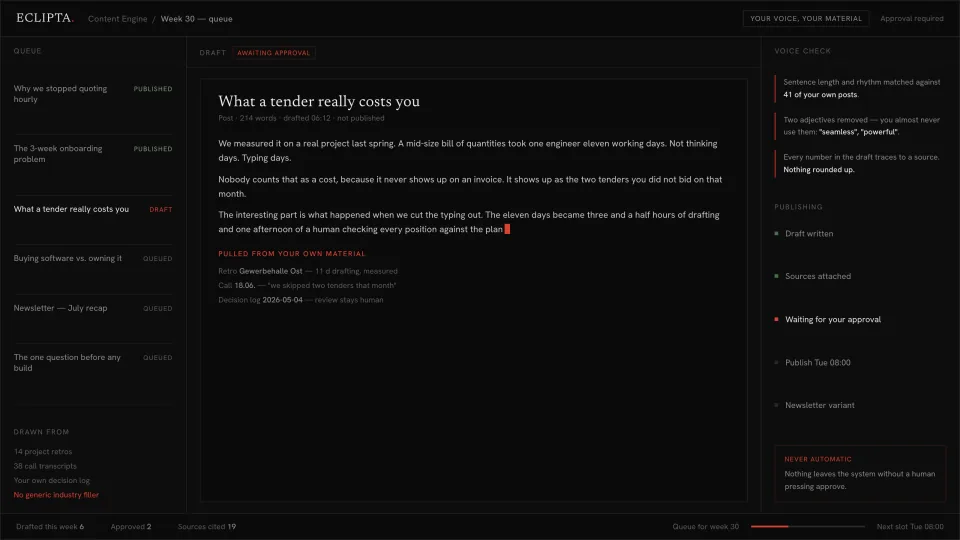
The mockup on the use case card shows a working week: a queue of topics, one draft waiting for approval, and a voice check next to it. Here is what sits behind that picture.
- 01
It reads what the company already produced
Project retros, call transcripts, the decision log, delivery reports, support threads. Not to publish them, but to know what actually happened. That is the difference between a system that writes about your industry and one that writes about your company. It reads the sources you point it at, nothing else.
- 02
It learns your voice from your own texts
Sentence length, rhythm, how you open, which words you never use, whether you round numbers or not. Built from the posts and emails you already wrote and approved. When a draft drifts, the drift is visible: the voice check says which words were removed and why, against how many of your own texts it compared.
- 03
It picks topics from real events, not from a calendar
A finished project, a decision that was hard, a result that surprised you, a question three clients asked in the same month. The queue fills itself from what happened. You can add or kill a topic at any point, and topics you kill stay killed.
- 04
Every claim carries its source
A number in a draft points back to the retro or the call it came from. If there is no source, the system does not smooth it over. It marks the gap and asks. Nothing is rounded up to sound better, because a published number that cannot be defended costs more than the post earns.
- 05
It stops at the approval line, every time
Drafting is automatic. Publishing is not. A draft sits in the queue with its sources attached until a human presses approve. Anything touching a client name, a price or a commitment goes to a person by default, no exceptions and no configurable shortcut.
- 06
After approval it handles the mechanics
Scheduling to the slot you chose, the newsletter variant of the same piece, the shorter version for a second channel, the archive copy that becomes source material for later drafts. This is the part that quietly eats an afternoon a week when a person does it.
Take this with you
A two part prompt that makes AI write in your voice
This is the useful core of the voice problem, in a form you can use today with any capable chat model. Part one turns five of your own texts into a written voice profile. Part two takes that profile plus one real decision from your business and writes a post from it, marking anything it cannot back up. It works. It is also the manual version of what the system does on its own.
PART 1: BUILD THE VOICE PROFILE
(Run once. Keep the output.)

You are analysing writing style, not content quality.
Below are five texts I wrote and published myself.
Produce a written voice profile with exactly these sections:
1. SENTENCE SHAPE: average length, shortest, longest,
   how often I use fragments, how I open a text.
2. EVIDENCE HABITS: what I use to prove a point
   (numbers, named examples, a story, a comparison),
   and how often per 100 words.
3. NUMBER DISCIPLINE: do I round, do I give ranges,
   do I name the source of a figure.
4. BANNED WORDS: 10 to 20 words and phrases that appear
   in generic business writing but never in my texts.
5. STRUCTURE: how I end. Do I conclude, ask, or stop flat.

Quote a short line from my texts as proof for each point.
Do not flatter the writing. Where the sample is too small
to judge, write UNCLEAR instead of guessing.

[PASTE FIVE OF YOUR OWN TEXTS, 200 WORDS MINIMUM EACH]

PART 2: WRITE THE POST
(Run per post. Paste the profile from part 1.)

VOICE PROFILE: [PASTE THE OUTPUT OF PART 1 HERE]

THE DECISION I AM WRITING ABOUT:
[WHAT WE DECIDED OR CHANGED]
[WHY: the situation that forced it]
[WHAT HAPPENED AFTER, with real figures if you have them]
[WHAT I WOULD DO DIFFERENTLY]

Write one post of 200 to 300 words in the voice profile.
Hard rules:
- Every factual claim must come from the decision above.
- Anything you would need to invent, write as [SOURCE MISSING]
  instead of writing it. Do not smooth over the gap.
- Do not round numbers I gave you. Do not add numbers.
- Use no word from the BANNED WORDS list.
- No summary paragraph at the end.

Then list, separately: every [SOURCE MISSING] marker and
what I would have to tell you to fill it.
- Collect five of your own published texts, at least 200 words each. Emails count. The more recent, the better.
- Run part one. Read the voice profile and correct it by hand where it got you wrong. It is a document, not an oracle.
- Save that profile somewhere you can find it. You will paste it into every future run.
- Run part two with one real decision from the last quarter. Fill the four fields honestly, including the figures you are allowed to publish.
- Read the [SOURCE MISSING] list at the bottom before you read the post. It tells you exactly which part of your own story you did not give it.
It is a prompt, so it forgets. The voice profile only exists as long as you keep pasting it, and it drifts once you paste it into a different model or a different chat. You still choose the topic, you still find the numbers, you still copy the result to the place it gets published. On post twenty the copy and paste is the work, and the voice has quietly become the average of twenty separate conversations.
Where the prompt stops and the system starts
The prompt solves one handgrip: turning a decision you already wrote down into a post that sounds like you.
The built system removes the two things around it. It finds the material itself, from the retros, calls and logs your company already produces, so nobody has to remember which project had the good numbers. And it holds the voice steady across hundreds of texts, because the profile is a fixed part of the system and not a paragraph someone pastes from memory.
The approval line does not move. Drafting, sourcing, scheduling and the newsletter variant run on their own. Publishing waits for a person, every single time, and anything that names a client or promises something is routed to a human before it ever reaches a draft queue.
- Topics come from real events inside the company, not from a content calendar
- The voice profile lives in the system and stays the same on post one and post three hundred
- Each claim links to the retro, call or log entry it came from
- Gaps are marked and asked about, never filled with plausible sounding filler
- Approved posts publish themselves on schedule, plus the newsletter and short variants
- Published pieces become source material for later drafts, so the system gets more specific over time
Frequently asked questions
Can I not just do this with ChatGPT?
For a single post, yes, and the prompt on this page is exactly how. The difference shows up at volume. A chat window has no access to your retros or call transcripts, so you feed it every fact by hand, and it holds your voice only as long as you keep pasting the profile. The system reads the material itself and applies one fixed profile to every draft.
How does AI learn to write in my voice?
Not by being told to be professional and friendly. It needs a written description of how you actually write: sentence length, what you use as evidence, whether you round numbers, and the words you never use. That description is built by analysing texts you already published. The prompt on this page produces one in a few minutes, and you should correct it by hand before you trust it.
Will the system publish something without me seeing it?
No. Drafting is automatic, publishing is not. Every draft sits in the queue with its sources attached until a human approves it. Anything touching a client name, a price or a commitment is routed to a person by default. That line is not a setting someone can switch off to move faster.
What happens to our data and our internal documents?
The system reads only the sources you point it at. Where it runs, which model it uses and whether anything leaves your infrastructure is decided during the build, not afterwards. Companies with strict requirements run it entirely on their own hardware. Nothing about the approach requires your retros to sit on someone else's server.
What does a content system like this cost, and how long does it take to build?
It is built for your company, so it is scoped and priced per case rather than sold as a seat licence. Scope drives it: how many sources it reads, how many channels it publishes to, how much existing material has to be made readable first. A narrow version that drafts for one channel from one source is a matter of weeks. Run the prompt on this page first, and the manual effort it costs you will tell you what the system is worth.
What if the system invents a number or a claim?
It is built not to. Every factual claim in a draft has to trace back to a source document, and where there is none, the gap is marked and raised instead of filled. The free prompt uses the same rule with a [SOURCE MISSING] marker, so you can see the mechanism working before you commission anything. A published figure you cannot defend costs more than any post earns.
We only have a handful of published texts. Is that enough to model a voice?
Five texts of about 200 words each is enough for a usable profile, and internal emails count. With less than that, write two or three pieces by hand first and use those. A profile built on too little material tends to overfit one mood, which is why the analysis is told to write UNCLEAR rather than invent a pattern it cannot see.
Bring one decision, not a content plan
The best first conversation is not about channels or frequency. It is about one thing your company decided in the last quarter that nobody outside the company knows about yet. If we can turn that into something worth publishing, everything after it is mechanics. Apply and tell us what that decision was.
Apply