
Real estate & construction
Draft a tender bill of quantities from your plans, position by position
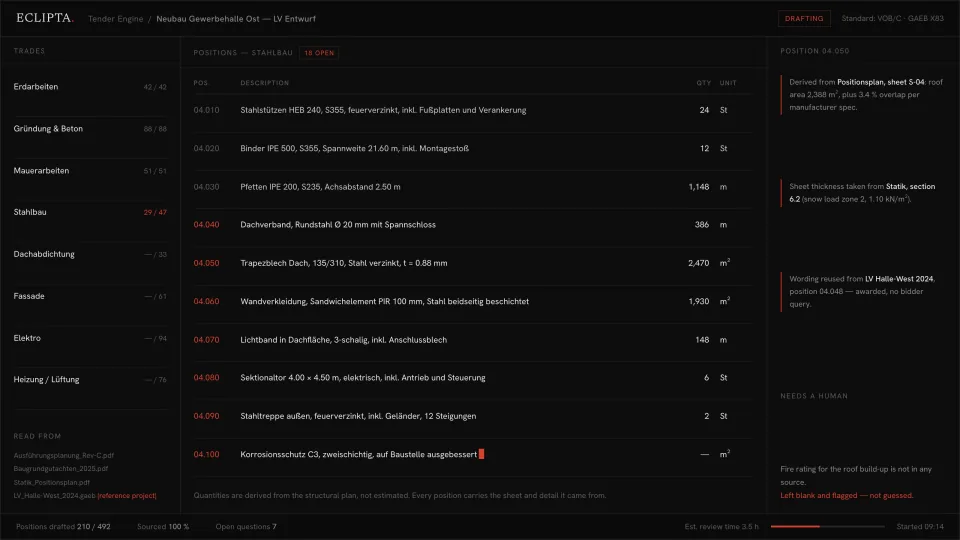
Eclipta builds systems that read your execution plans, soil and structural reports and your own awarded tenders, then draft the bill of quantities line by line. Every quantity carries the sheet it came from. Where a source is missing, the position stays blank and flagged, and a person decides.
Why tender preparation still eats weeks of engineering time
A bill of quantities is not creative work. It is the mechanical consequence of drawings that already exist. Someone opens the execution plan, counts columns, measures roof area, checks the structural report for a sheet thickness, then writes a position, a unit and a quantity. Then repeats that four hundred times across eight trades.
The knowledge that makes this fast is already in the office. Last year's awarded tender for a comparable hall has wording that no bidder queried. The estimator knows which positions always get forgotten. None of that is in a system. It is in one person's head and in a folder of old files nobody has time to search under deadline.
So the work gets done late, by the most expensive people in the building, at the point in the project where a mistake costs the most. A missing position becomes a change order. A wrong quantity becomes a dispute. A guessed specification becomes a liability.
- Senior engineers spend days on counting and measuring instead of judgement.
- Position wording gets rewritten from scratch although a proven version exists in an earlier tender.
- Quantities live in a spreadsheet with no trace back to the sheet they came from.
- Trades that come last in the schedule get the least attention, and the most omissions.
- Nobody can say afterwards why a quantity is what it is, only who typed it.
- Deadlines force estimates where the plan set actually contained the answer.
How an automated bill of quantities system actually works
The system is built around your plan set, your standard and your own past tenders. It drafts, it sources, and it stops where the sources stop. It never fills a gap with something plausible.
- 01
It reads the whole document set, not a snippet
Execution planning, structural position plan, soil report, manufacturer data sheets, and your reference tenders in GAEB or Excel. All of it at once, per revision, so a revised sheet updates the positions that depend on it instead of silently going stale.
- 02
It derives quantities instead of estimating them
Roof area comes from the geometry on the sheet, plus the overlap the manufacturer specifies. Column count comes from the position plan. Sheet thickness comes from the structural calculation section that fixed it. Each number is written together with the sheet and detail it was taken from.
- 03
It writes positions in your language, not generic text
Wording is reused from your own awarded tenders where a comparable position exists, because that text has already survived a bidding round. Numbering, trade structure and units follow your standard, so the output lands in your existing template rather than next to it.
- 04
It flags what no source answers
If the fire rating of the roof build-up appears in no document, the position stays open and is marked as an open question. It is never invented. The reviewer gets a short list of decisions to make instead of a long document to double check.
- 05
A person reviews and releases
The draft goes to the responsible engineer with every derivation visible. Review is a reading task, not a rebuild. Nothing leaves the office, and nothing goes to a bidder, without a human release.
Take this with you
A free prompt: turn one plan extract into draft positions
This works today, in any capable chat model, with no setup. Paste a section of an execution plan, a structural note or a soil report, and it returns the positions that follow from that text, each with trade, unit and how the quantity was derived. It separates what the text supports from what is an assumption, and it refuses to invent a number.
You are an experienced quantity surveyor drafting positions for a
bill of quantities (Leistungsverzeichnis). You work strictly from the
text I give you. You never invent a number.

SOURCE TEXT:
[PASTE THE PLAN EXTRACT, STRUCTURAL NOTE, SPECIFICATION OR REPORT SECTION]

PROJECT CONTEXT:
Type of building: [E.G. SINGLE STOREY COMMERCIAL HALL, NEW BUILD]
Standard to follow: [E.G. VOB/C, NRM2, POCT, OR "HOUSE STANDARD"]
Trade in focus: [E.G. STRUCTURAL STEEL, OR "ALL TRADES CONTAINED"]
Units to use: [E.G. METRIC: St, m, m2, m3, kg]

Produce a table with these columns:
1. Trade
2. Draft position text, in the wording style used in tenders
3. Unit
4. Quantity
5. Derivation: the exact sentence or value in the source text the
   quantity comes from, quoted
6. Status: SUPPORTED or ASSUMPTION

Rules:
- SUPPORTED means the quantity or specification is stated in, or
  directly calculable from, the source text. Quote the basis.
- ASSUMPTION means it is normal practice but not in the text. Then
  leave the quantity empty, write the assumption in plain words, and
  say what document would settle it.
- Never estimate a quantity to fill a gap. An empty cell is correct.
- If the text fixes a material, grade, thickness or load, carry it
  into the position text verbatim.
- Keep position text factual: material, dimension, grade, treatment,
  and what is included.

After the table, add two short lists:
A. OPEN QUESTIONS: what a human must decide before this goes out.
B. LIKELY MISSING POSITIONS: positions this trade usually needs that
   the source text does not cover, marked clearly as a prompt for
   the reviewer, not as drafted work.
- Copy the prompt into a chat model and fill the four bracketed context lines.
- Paste one coherent extract, for example a single sheet note or one section of the structural report, rather than a whole plan set.
- Read the Status column first. Everything marked ASSUMPTION is a question for you, not an answer.
- Check each SUPPORTED row against the quoted derivation before you copy it into your tender template.
- Repeat per section, then merge the tables yourself and check for duplicates across sections.
The prompt works on the extract you paste. It does not open your plan set, so it cannot read a dimension off a drawing, follow a revision, or notice that sheet S-04 contradicts sheet S-07. It does not know your office: not your numbering, not your trade structure, not the wording from the tenders you have already won. It cannot tell you whether the bill of quantities is complete, because it has never seen the rest of the project. And you still merge, deduplicate and format everything by hand.
Where the prompt stops and the built system begins
The prompt gives you one good handgrip: text in, sourced draft positions out. The built system removes the copy and paste around it, and adds the two things a chat window structurally cannot have, which are your whole document set and your own history.
It works across the full plan set at once, so completeness becomes checkable instead of a matter of memory. It knows your reference tenders, so a position that was awarded without a single bidder query gets reused instead of rewritten. And it holds the honesty rule at scale: everything unambiguous is drafted automatically, everything ambiguous waits for a person, and anything that touches money or a commitment goes to a person by default.
- Reads the complete plan set, reports and manufacturer data, per revision, instead of one pasted extract.
- Reuses wording and numbering from your own awarded tenders, in your trade structure.
- Derives quantities from the geometry and calculations in the documents, and records the sheet and detail for each one.
- Checks the bill of quantities for missing positions across trades, which no single extract can do.
- Exports into your working format, for example GAEB, instead of a table you retype.
- Delivers a list of open questions for review, and releases nothing without a human.
Frequently asked questions
Can AI really create a bill of quantities from construction plans?
It can draft one, and that is the useful part. Quantities that follow from geometry and from stated specifications can be derived reliably and traced back to the sheet they came from. What cannot be automated is judgement: scope decisions, risk allocation, anything a document does not settle. Those stay with the engineer, which is why the system flags them instead of filling them in.
How accurate are the quantities, and what happens when a source is missing?
Every quantity is written together with its derivation, so accuracy is checkable rather than a matter of trust. If a specification is not in any document, the position is left blank and marked as an open question. The system is built to leave a gap visible instead of closing it with a plausible guess, because a wrong number in a tender is far more expensive than a missing one.
Why not just do this with ChatGPT?
For a single extract, you should, and the prompt on this page is exactly that. It breaks down at scale: a chat window has no access to your plan set, no memory of your past tenders, no revision handling, and no way to check whether the bill of quantities is complete. You also end up doing the copy, paste, merge and format work yourself for every section, which is most of the time the tender actually costs.
Does the system work with our tender format and standard, for example VOB/C and GAEB?
Yes. The system is built around your structure, not a template of ours. Trade breakdown, numbering, unit conventions and export format follow what your office already uses, so the draft lands inside your existing process. Adapting to your standard is part of the build, not an add on.
Where does our project data go, and who can see our plans?
Plans, reports and past tenders are commercially sensitive, so the system is built to keep them where they belong. It runs against your own storage and, where required, on your own infrastructure. Nothing is used to train anyone's model, and access follows the rules your office already has for project files.
What does a system like this cost, and how long does it take to build?
It is a build, not a subscription per seat, so it is scoped against your tender volume and the number of trades you want covered first. Most builds start narrow, with one trade and one reference project, so you see real drafted positions from your own documents early rather than after a long integration. Concrete scope and price come out of an initial conversation about your current tender process.
How much review work is left for the engineer?
Reading rather than rebuilding. The draft arrives with derivations visible per position and a short list of open questions, so review time goes into the decisions that need a human. Nothing is released to a bidder automatically. The final tender is always signed off by a person.
Have your next tender drafted from your own documents
If tender preparation is currently the bottleneck in your office, tell us how your bills of quantities are produced today, which standard you work to, and what your reference projects look like. We take on a small number of builds at a time.
Apply