
Behavio · Ilija, CEO & Founder
Margins doubled on the same revenue.
Behavio is an agency that moved its delivery onto the system and grew while the team got smaller. Ilija runs it. The result on the same revenue was double the margin.
- Result
- Margins doubled on the same revenue.
- Scale
- €100k months, leaner team
- Who
- Ilija, CEO & Founder
Where an agency loses its margin
An agency sells outcomes and pays for hours. Every point of margin lives in the gap between the two, and delivery is where that gap closes. The work itself is rarely the problem. What costs money is everything around it: reading the brief again because half of it was in a call, waiting on an asset, rebuilding a setup that was already built for another client last month, and the second and third pass on a draft that missed the client's tone.
The second cost is that the standard sits in people rather than in the business. One person's work comes back clean and another's needs an hour of editing, so the senior becomes the quality gate for everything. That works until it is the constraint. Growth then means hiring, hiring means training, training costs the senior's time, and the margin the new client was supposed to bring goes into absorbing them.
So the usual answer to more work is more people, and it moves the margin sideways instead of up. Each new client adds coordination, not just production. At some point the agency is busier, larger, and no more profitable than it was two years earlier.
- The same setup steps get done by hand for every new client, slightly differently each time.
- A deliverable waits two days because one person has not answered one question.
- Quality depends on who picked up the task, so everything routes through the same senior reviewer.
- Work is repeated because the last version of it lives in somebody's folder rather than in the process.
- Nobody can say what a project actually costs to deliver until it is finished.
- Taking on the next client means a hire, and the hire eats the margin the client brought.
What the system does for client work
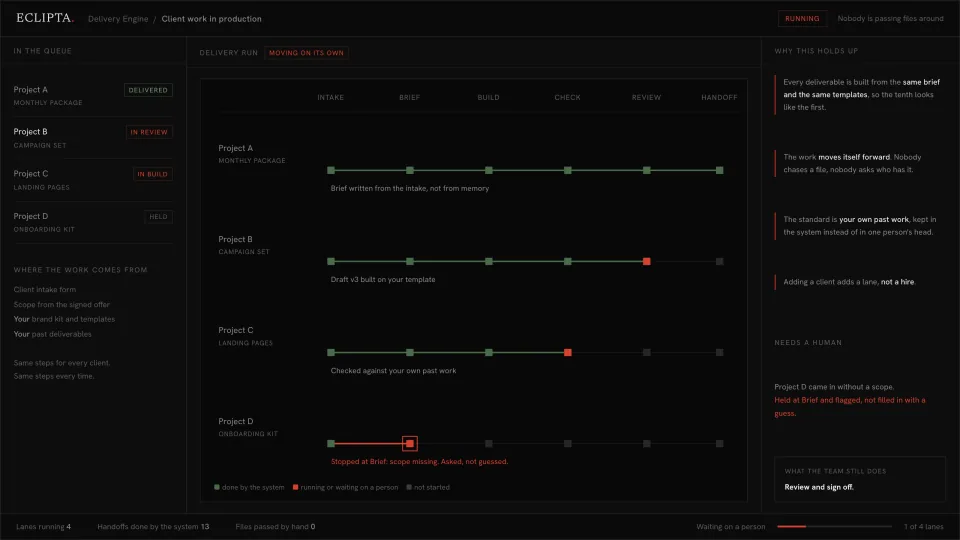
We build the delivery itself, not a dashboard about it. The steps a project passes through become a run the system executes: intake, brief, build, check, review, handoff. The same steps for every client, every time. A person stays in the loop where judgement is worth paying for, and the system stops rather than guesses everywhere else.
- 01
Intake becomes structured input
What the client sends and what was agreed in the offer land in one place, in a fixed shape, at the start of the project. Nothing later in the run depends on somebody remembering what was said in a call. If something required is missing, it is missing visibly, on day one rather than in the review.
- 02
The brief is written from the record
The brief is generated from the intake and the scope, not from memory. That removes the most expensive kind of rework, the kind where the work was done well against the wrong understanding.
- 03
The work is built against your own standards
Your templates, your brand kit and your past deliverables become the material the system builds from. The standard stops being a thing the senior carries in their head and becomes a thing the business owns, which is what makes the tenth deliverable look like the first.
- 04
It checks before a person does
Every output is graded against the same criteria you would apply in review: scope covered, tone right, the things that are always wrong the first time. The reviewer receives a version that has already failed and been fixed once, so review is a judgement call rather than a proofread.
- 05
Handoffs happen without anyone chasing
A finished step moves the work forward on its own, with the context attached. Most of the waiting in an agency is not work, it is a file sitting between two people. That is the part that disappears first.
- 06
A new client is a new lane, not a new hire
Because the run is defined once and executed per project, capacity is added by starting another lane rather than by adding a person to coordinate. This is the mechanism behind delivering more without the team growing to match.
- 07
It stops and asks instead of guessing
A project that arrives without a clear scope is held at the brief and flagged, not filled in with a plausible assumption. Anything touching price, a client commitment or a judgement about quality goes to a person by default. The system produces and checks. Approving and sending stay human.
What came out of it
Behavio moved its delivery onto the system and grew while the team got smaller. On the same revenue, the margin doubled.
That is the shape of the result worth paying attention to. Revenue did not have to move for the business to become more profitable, because the cost of producing the work fell rather than the price of it rising. Running at €100k months with a leaner team is the same statement said the other way around.
- Margins doubled on the same revenue.
- €100k months, leaner team.
- Delivery runs on the system, so growth did not require the team to grow with it.
What this case does not claim
This case shows one agency's outcome: the margin doubled on the same revenue, at €100k months with a leaner team. It does not claim that the system alone produced it. An agency that gets this result also sells, prices and manages clients well, and we have no way to separate those contributions, so we do not pretend to.
It is also not a forecast for your business. What transfers is the mechanism, which is delivery that runs as a defined process instead of as coordinated handwork. What that is worth depends on how much of your margin currently goes into repetition and waiting, and that is answerable before anything is built.
Frequently asked questions
How does an agency increase its profit margin without raising prices?
By lowering what a delivered project costs to produce. In most agencies a large share of the hours on a project are not the craft itself, they are the setup, the chasing, the second pass on a draft that missed the brief, and the senior review that catches the same issues every time. Those hours are repeatable, which means they are the ones a system can take over. The price stays where it is and the cost underneath it falls.
Can an agency deliver more work without hiring more people?
Yes, when the delivery is a defined process rather than a set of habits. If every project runs the same steps in the same order, adding a client means starting another lane, and the coordination cost of that lane is close to zero. If delivery lives in people's heads, every new client needs a person to hold it, and headcount grows with revenue. The question is not how good your team is, it is whether the process exists outside of them.
How do you keep quality consistent across clients without adding reviewers?
The standard has to be written down somewhere other than a senior's judgement. We build it from your own past work, your templates and your review criteria, and the system grades each output against them before a human sees it. The reviewer then looks at a version that has already been checked once, so one person can hold the quality bar for a lot more work than before.
What parts of agency delivery should stay with people?
Anything where being wrong is expensive and judgement is the product: the client relationship, pricing, scoping, strategic calls, and the final sign off on what goes out. We do not automate those, and we say so before the build. The parts worth automating are the repeatable ones, and being clear about the boundary is what makes the automated parts trustworthy.
What happens when a project comes in incomplete?
It stops. A missing scope or a missing asset holds the run at that step and flags it for a person, rather than being filled in with the most plausible guess. An agency system that invents the missing half produces work that looks finished and fails in review, which costs more than the delay it saved. Stopping visibly is the feature.
Does this replace the tools our agency already uses?
Usually not. The delivery run sits on top of where your work and files already live, and it produces into the formats you already send to clients. Replacing a working tool is a cost with no return. What tends to be missing is not another tool, it is the process that moves work between them without a person carrying it.
How long does it take before it affects margin?
The first useful version is a matter of weeks, because it starts with one service you deliver repeatedly rather than everything the agency does. That is also the honest test: if the most repeated deliverable in your business does not benefit, the rest will not either. We tell you which parts are worth building and which are cheaper left manual before the build starts.
Bring us the work you deliver most often
If your margin is going into repetition, waiting and rework rather than into the craft, that gap is the project. Apply, tell us what you deliver, how often, and what a project costs you to produce today, and we will tell you honestly whether this is worth building for you.
Apply